
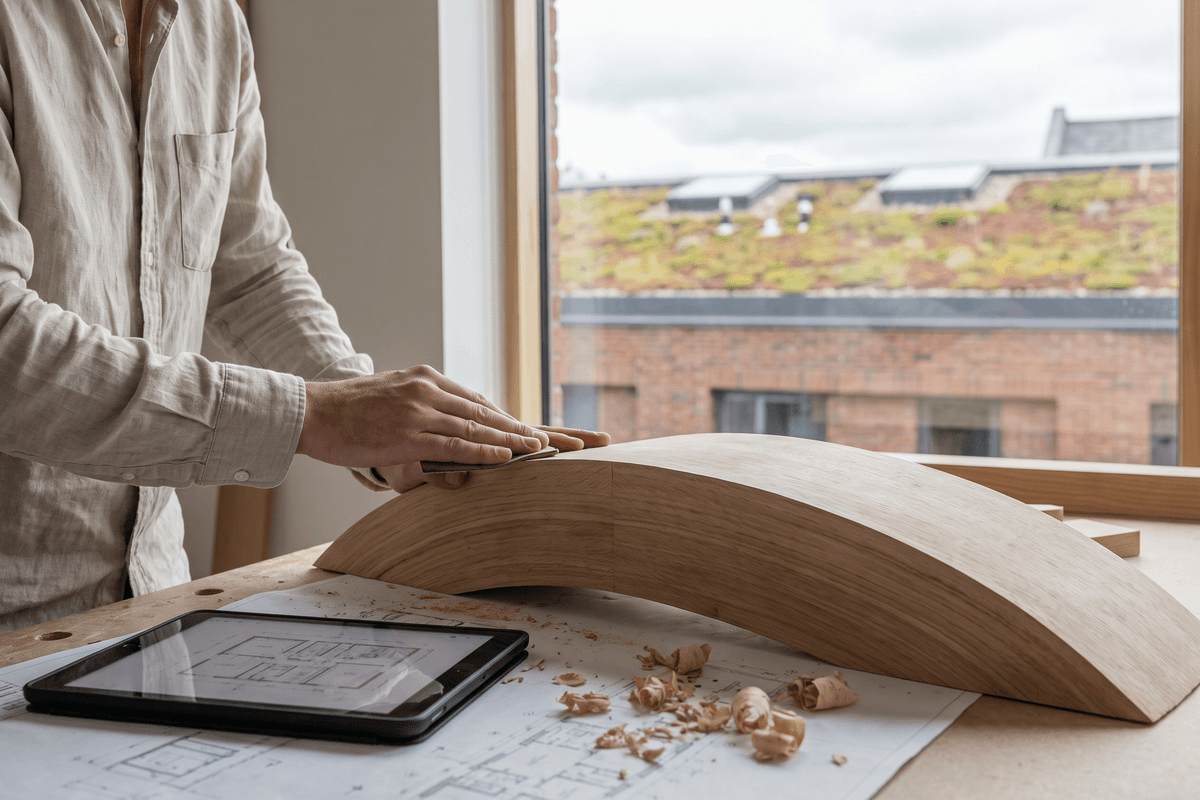

American architectural practice is witnessing a profound recalibration of how material authenticity, computational design, and civic storytelling intersect. From the precise digital fabrication of public urban interventions to the carbon-conscious assembly of major institutional landmarks, firms across the country are moving past generic spectacle toward deeply tactile, context-driven design. Two recent project milestones—the University of Virginia School of Architecture’s retrospective on FUTUREFORMS and COOKFOX’s completion of the Bruce Springsteen Center for American Music—encapsulate this dual evolution across micro and macro scales of practice.
The Philosophy of 'Metaxis': Computational Craft in the Public Realm
At the University of Virginia School of Architecture, the exhibition Metaxis: A Collection of Ideas and Objects showcases ten years of research, public art, and urban installations by San Francisco–based experimental studio FUTUREFORMS. The term metaxis—derived from classical philosophy to describe the state of "in-betweenness"—serves as an apt operational framework for modern practice. FUTUREFORMS operates precisely at the threshold between the digital algorithm and physical craft, translating parametric geometry into structural metalwork, responsive daylight screens, and dynamic public pavilions.
For mid-sized and boutique design studios, the work presented at UVA demonstrates that computational design is no longer an academic abstraction or a tool reserved solely for mega-firm façade optimization. Instead, it has matured into an accessible method of tectonic fabrication. By retaining end-to-end control over algorithmic generation, tooling pathways, and shop-floor assembly, design teams can deliver bespoke public realm interventions that defy the standard kit-of-parts without ballooning construction budgets.
"Computational craft is not merely about algorithmic complexity; it is about reclaiming the physical intimacy between the designer's intent and the material reality of fabrication."
Key Lessons from the Metaxis Retrospective:
- Direct-to-Fabrication Pipelines: By bypassing traditional shop drawing translation layers, architects reduce risk, eliminate rework, and maintain design fidelity.
- Tactile Urban Activation: Public installations function as localized urban testing beds, proving high-performance structural systems before scaling them to building enclosures.
- Iterative Material Research: Academic exhibitions double as valuable R&D documentation, creating a visible pedigree that helps secure complex public art and municipal infrastructure commissions.
Material Authenticity at Scale: Mass Timber and Cultural Memory
While FUTUREFORMS investigates the micro-tectonics of parametric assembly, COOKFOX demonstrates how material storytelling scales to regional cultural infrastructure. The newly completed 30,000-square-foot Bruce Springsteen Center for American Music articulates American musical history not through static museum vitrines, but through an intensely tactile, biophilic architectural envelope.
Anchored by an extensive mass timber structural frame and biophilic spatial sequencing, the building represents a major step forward for institutional sustainability in the Mid-Atlantic region. Rather than masking the building’s structural logic behind drywall and decorative cladding, COOKFOX brings glue-laminated columns, cross-laminated timber (CLT) panels, and expressive joinery to the forefront, creating a sensory environment that reflects the raw, unvarnished ethos of the music it celebrates.
| Design Dimension | Computational Craft (FUTUREFORMS) | Institutional Mass Timber (COOKFOX) |
|---|---|---|
| Primary Scale | Urban pavilions, public art, bespoke façades | Civic, institutional, cultural facilities (30k+ sq ft) |
| Tectonic Medium | Form-finding metals, polymer composites, parametric joints | Mass timber (Glulam & CLT), regional stone, high-performance glazing |
| Sustainability Driver | Material efficiency through structural optimization | Embodied carbon reduction, biophilia, bioclimate integration |
| Practice Methodology | Digital prototyping & direct CNC/robotic tooling | Integrated project delivery, early timber trade involvement |
The Strategic Convergence: Bridging Algorithmic Logic and Low-Carbon Tectonics
While operating at different scales, the methodologies of FUTUREFORMS and COOKFOX point toward a unified trajectory for American architecture firms navigating the remainder of 2026. The next frontier of high-performance design lies in uniting the precision of computational geometry with the imperative of low-carbon, bio-based materials.
1. Decarbonization Demands Expressive Structure
As structural systems shift from carbon-intensive steel and concrete toward mass timber and optimized composites, structure once again becomes the primary architectural expression. Projects like the Springsteen Center prove that clients are increasingly receptive to exposed timber frames that communicate environmental stewardship while elevating user wellness.
2. Algorithmic Optimization Mitigates Material Waste
The lessons from FUTUREFORMS’ decade-long portfolio highlight how parametric modeling can minimize cut-off waste, optimize structural loads across curved geometries, and streamline manufacturing. Applying these algorithmic principles to mass timber CNC milling and panel layout allows firms to shave critical percentages off material procurement costs.
3. Cultural Authenticity Trumps Globalized Genericism
Both projects push back against placeless, glass-box modernism. Whether celebrating the tactile resonance of American roots music in New Jersey or engaging public pedestrians with light-filtering urban structures, successful 2026 projects anchor themselves in specific cultural and environmental narratives.
Practical Recommendations for U.S. Design Leaders
- Invest in Internal Fabrication Literacy: You do not need an in-house robotic arm to benefit from computational fabrication. Upskilling project architects in parametric scripting (Grasshopper, Dynamo) and understanding CNC tooling constraints enables smarter collaboration with specialty fabricators.
- Engage Mass Timber Trade Partners Early: The structural success of projects like COOKFOX’s cultural center depends on onboarding mass timber suppliers and structural engineers during Schematic Design to lock in procurement lead times and panel sizing.
- Treat Public Prototyping as R&D: Pursuing public art, micro-installations, and academic partnerships offers a low-liability environment to pilot innovative materials, custom connections, and digital fabrication workflows before deploying them on commercial commissions.
Looking Forward: The Rebirth of the Master Builder
The juxtaposition of FUTUREFORMS’ computational craft at UVA and COOKFOX’s mass timber landmark highlights an encouraging trend: the restoration of the architect as a master of material craft and tectonic execution. As digital tools become more deeply embedded in physical fabrication, the boundary between design and making continues to dissolve. For American practices seeking relevance and resilience, the mandate is clear: embrace the in-between space where digital precision, low-carbon engineering, and authentic storytelling meet.